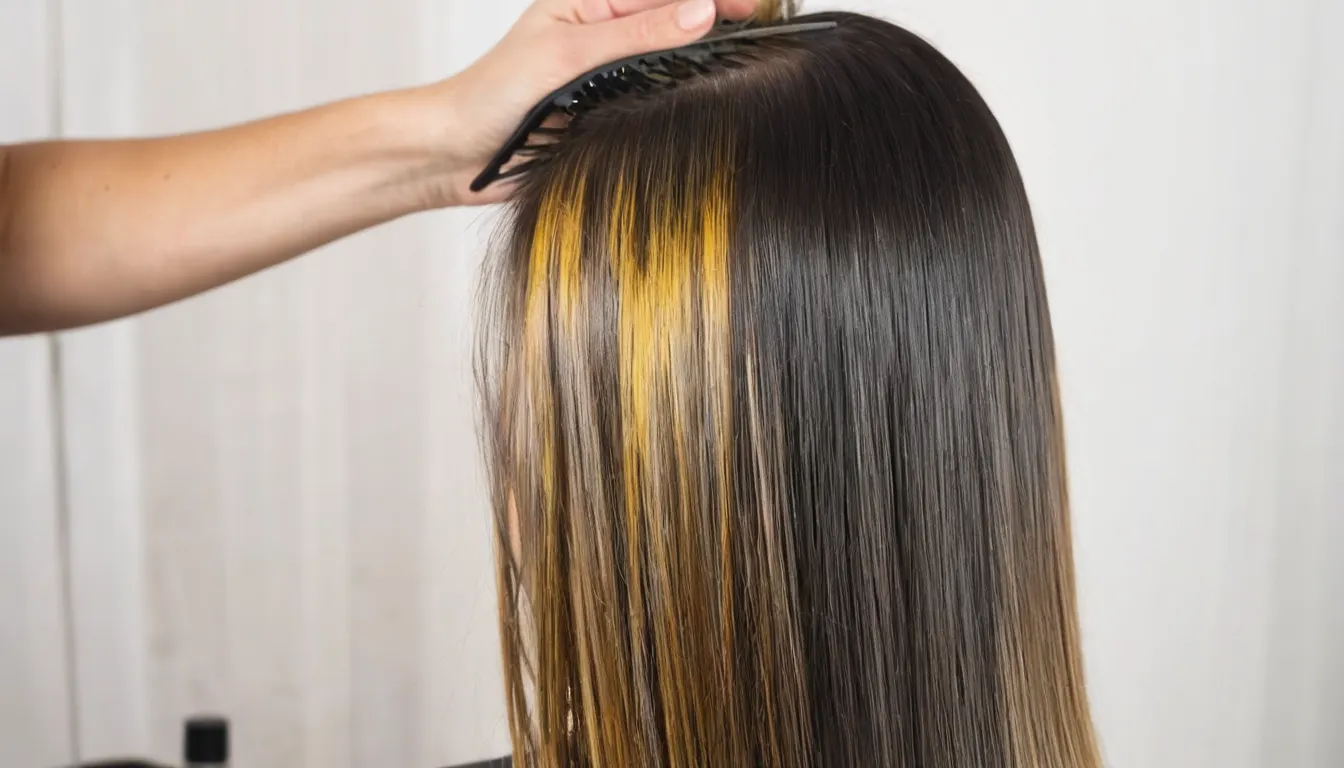
Safety first. Do an allergy patch test 48 hours before every permanent or demi-permanent colour, even a brand you have used before, and a strand test to check the result. Many oxidative dyes contain PPD (para-phenylenediamine) or related chemicals that can cause serious allergic reactions. This site gives general information, not medical advice: if you react, rinse the product off and get medical help.
How bleach and lightener work
Lightening products use an oxidising agent (usually hydrogen peroxide, called developer) in an alkaline formula to break down melanin inside the hair. As the dark pigment breaks down, the warm stages show through: red, then orange, then gold, then yellow. The levels page lists them.
Permanent colour, high-lift tint or bleach
| Method | Typical lift | Works on old dye? |
|---|---|---|
| Permanent colour | About 1 to 3 levels on natural hair | No |
| High-lift tint | Up to about 4 levels on natural, fairly light hair | No |
| Lightener (bleach) | Several levels, depending on hair and time | Yes, though unevenly |
Exact lift depends on the product, the developer, your hair and its history, so check the manufacturer's guidance.
Developer volumes: 10, 20, 30 and 40
| Volume | Peroxide | Common use |
|---|---|---|
| 10 vol | 3% | Toners, deposit-only colour, very gentle lift |
| 20 vol | 6% | Grey coverage and standard 1 to 2 level lift |
| 30 vol | 9% | Extra lift, usually off the scalp |
| 40 vol | 12% | Professional off-scalp use; higher risk of damage and irritation |
A higher volume works faster, and that is all. Slower lift with a lower volume is usually kinder to the hair and scalp. Many lighteners are labelled for off-scalp use only above a certain strength.
Patch test and strand test
- Allergy patch test, 48 hours before. Follow the product leaflet exactly. If you get itching, burning, redness or swelling, don't use the product.
- Strand test. Lighten a small hidden section to see how far it lifts, how long it takes, and whether the hair stays strong. If the strand turns gummy, stretchy or snaps, stop.
When not to bleach your hair at home
- Your scalp is sore, sunburnt, broken or irritated.
- You've had a reaction to hair dye, or to a temporary black henna tattoo, in the past. Those can sensitise you to PPD.
- Your hair has box dye, henna or other plant dyes on it. Some products, particularly those with metallic salts, can react with lightener.
- Your hair already feels weak, stretchy or breaks easily.
- You want to go from very dark to very light. That usually needs several sessions and is better done by a professional.
During and after lightening
- Wear gloves, work in a ventilated room, and keep products away from eyes, brows and lashes.
- Never exceed the maximum processing time on the pack, and don't apply heat unless the instructions say so.
- Rinse thoroughly, condition, and tone if needed. See toning.
- Bond-building treatments can help limit damage, but they don't make lightening risk-free.
If a product burns badly, rinse it off with plenty of cool water straight away. If you have swelling, blistering, or any difficulty breathing, get urgent medical help.
Lightening questions
How many levels can permanent hair colour lift?
About 1 to 3 levels on natural hair, and high-lift tints up to about 4 on natural, fairly light hair. Neither lifts old dye. Check the product's own guidance.
Is 40 volume developer safe to use at home?
40 volume (12%) is for professional off-scalp use and carries a higher risk of damage and irritation. Lower volumes with slower lift are usually kinder.
Why does my hair turn orange when I bleach it?
Lightening breaks down dark pigment first and leaves warm pigment behind. Orange shows around levels 6 and 7, and the levels chart shows each stage.